
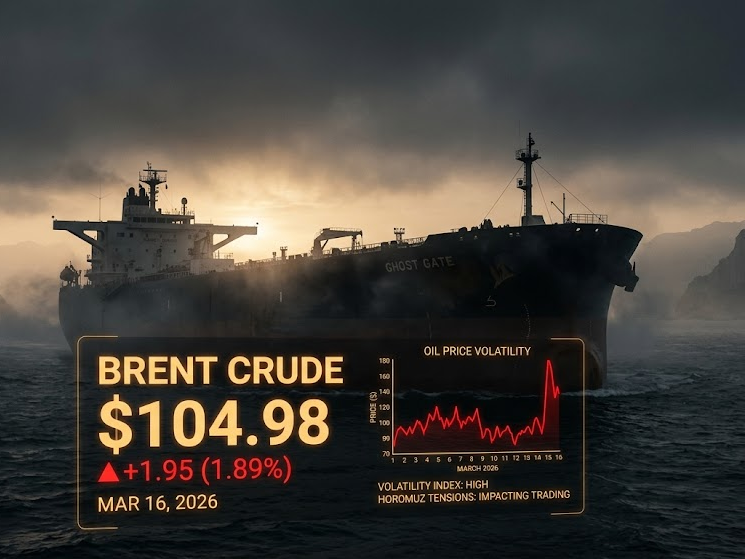
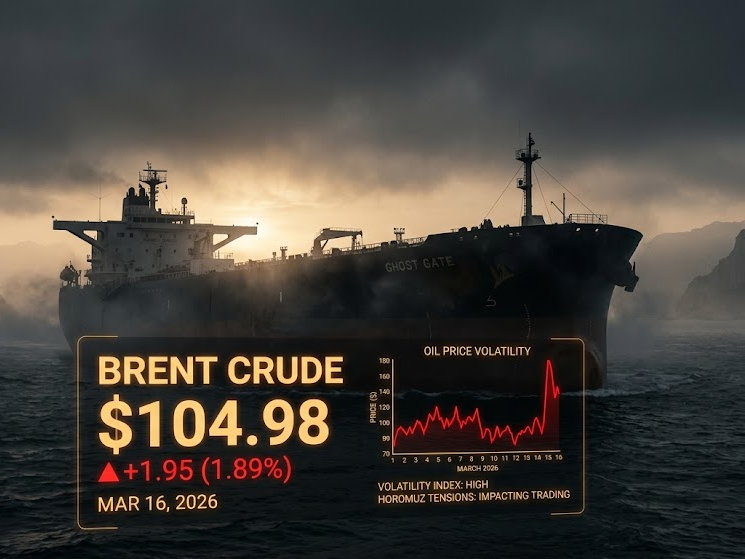
March 16, 2026 — Forget the historical averages. Forget the traditional supply-and-demand spreadsheets. If you are trading energy in March 2026, you aren’t looking at tankers; you are looking at a map of the Strait of Hormuz that has effectively become a “Ghost Gate.”
The escalating tensions in the Middle East have transformed the world’s most vital maritime chokepoint into a financial black hole. As Brent Crude surges past $105 and WTI breaches the $101 mark, the market is grappling with a reality that feels more like a geopolitical thriller than a standard trading cycle. Here is the breakdown of how the Hormuz “Ghost Gate” is dismantling global markets this month.
1. The Actuarial Blockade: Insurance as a Weapon
The most significant trend in March isn’t the physical presence of naval blockades—it’s the disappearance of insurance coverage. For decades, the Strait of Hormuz was a manageable risk. Today, it is an uninsurable one.
Main Point: War Risk Premiums have spiked by over 1,100% since February. In early 2026, insuring a single VLCC (Very Large Crude Carrier) for a transit through the Gulf cost approximately $650,000. As of this week, London underwriters are quoting $7.8 million per voyage, if they provide a quote at all. This “Actuarial Blockade” has effectively grounded the global fleet. When the insurance industry stops backing the hulls, the oil stops moving. This isn’t just a supply disruption; it’s a systemic freeze of the logistics chain that has created a permanent floor for prices.
2. From Disruption to Destruction: The Kharg Island Factor
Traders were already on edge following the February strikes, but the reported “kinetic decommissioning” of the Kharg Island export terminal has changed the math from temporary to terminal.
Main Point: The market has shifted from pricing “delivery delays” to pricing “permanent capacity loss.”
Kharg Island historically handled 90% of Iran’s crude exports. With its infrastructure severely compromised, roughly 1.5 to 2 million barrels per day (bpd) have been scrubbed from the global supply map. Unlike a blockade, which can be lifted with a diplomatic signature, a destroyed terminal takes years to rebuild. This “permanent subtraction” is why we are seeing such aggressive “backwardation”—where current prices are significantly higher than future prices—as refineries scramble for every available physical drop.
3. The LNG Domino: Asia’s Energy Sovereignty at Risk
While crude oil gets the headlines, the Strait of Hormuz is also the primary exit for 20% of the world’s Liquefied Natural Gas (LNG). The March trading session has been defined by QatarEnergy’s declaration of Force Majeure on several shipments destined for Asia.
Main Point: The Hormuz crisis is triggering a secondary “Energy Poverty” shock in emerging markets.
Nations like India, Bangladesh, and Vietnam, which rely heavily on Qatari LNG for power generation, are now facing a catastrophic deficit. With the “Ghost Gate” shut, these countries are being forced into the “spot market,” competing with wealthy European nations for limited US and West African supplies. This is driving a massive devaluation of the Indian Rupee (INR) and other regional currencies, as their trade balances are decimated by $100+ oil and record-high gas prices.
4. The Algorithm Panic: Volatility as the New Baseline
On the trading floor, the “human” element is being overwhelmed by algorithmic responses to satellite imagery and social media sentiment. In March 2026, a single unverified drone sighting near the Strait can trigger a $3 swing in price within sixty seconds.
Main Point: Liquidity is drying up as traditional “long” investors flee the extreme intra-day volatility.
We are seeing a “hollowing out” of the market. High-frequency trading bots are feeding on the volatility, while institutional pension funds—the “smart money”—are moving to the sidelines. This creates a dangerous feedback loop: lower liquidity leads to sharper price spikes, which in turn scares off more investors.